Built Ford Tough on the dyno: how four months replace a decade of pickup ownership
 ford.com
Before going on sale, Ford pickups spend four months at Michigan Proving Grounds — the equivalent of 10 years and 241,000 km of hard use.
Ford has once again reminded everyone that Built Ford Tough isn’t just an advertising line. Before going on sale, the brand’s pickups are run through a punishing program at the Michigan Proving Grounds, where 10 years of hard service and 150,000 miles — roughly 241,000 km — are packed into just four months.
For Ford, this is no PR clip for the sake of nice footage. Pickups in the United States are a culture and a serious business in their own right: they account for about 16% of new-car sales, and the entire segment moves somewhere between 2.7 and 3.1 million vehicles a year. The F-Series has dominated the chart for decades — 49 straight years as the best-selling pickup and 44 years as the best-selling vehicle in the country. On the proving grounds, the trucks aren’t treated gently. They’re not validated against the script of a careful owner who drives solo with an empty bed.
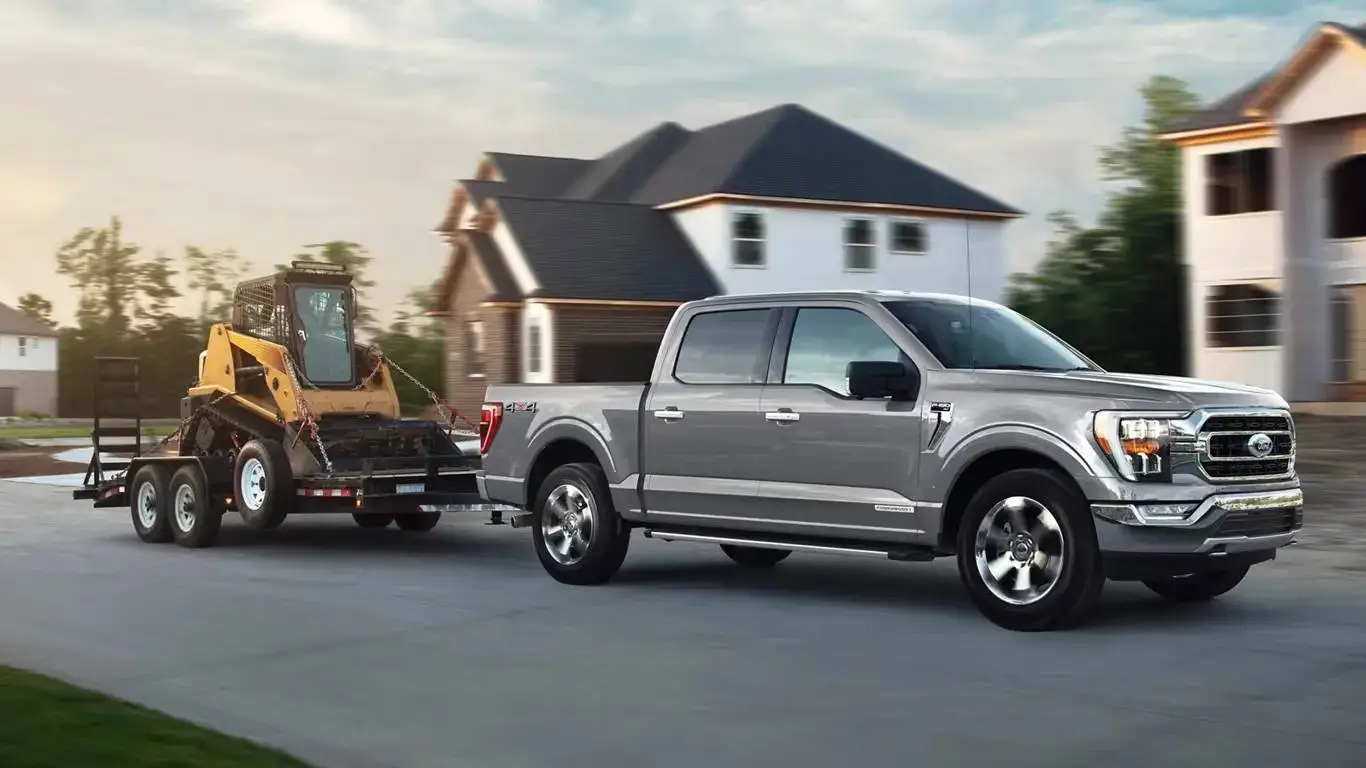
The pickups are thrashed over broken surfaces, sent through water crossings, strapped to dynos and driven up Power Hop Hill, a stepped climb that hammers the suspension and driveline under load. Crucially, the trucks aren’t tested empty. Engineers load the bed, fill the cabin with passengers and watch how the pickup behaves at maximum mass. For this class of vehicle it matters: in real life the F-Series tows trailers, works on construction sites, runs across farms and often serves as the family’s only car for every job that comes along.
Some of the testing is handled by robots. The high-speed oval can run up to 20 robotic drivers at once, repeating laps at identical speeds with high precision so engineers get clean data. A human can’t drive that long and that consistently.
But people haven’t been pushed out of the loop. Human testers are needed where sensors don’t always tell the full story — noises, vibrations, steering feel, odd suspension behaviour, sensations under braking or acceleration. Sometimes a problem is heard or felt first and only later shows up in the data. For the buyer, the logic is simple.
A weak point is far better found on a proving ground than discovered after the sale, when the truck is already hauling cargo, towing a trailer or grinding down a bad road far from the nearest dealer. Especially in the US, where a pickup is rarely just a weekend toy — it’s a work tool and family transport rolled into one.
Ford deliberately scripts a worst-owner scenario for its pickups in advance: overloads, impacts, water, heat, cold and constant driving without breaks. If a truck can take all of that in four months, it stands a much better chance of holding up in the hands of an ordinary owner.