Mazda Patent: MX-5 Successor or Iconic SP in Disguise?
 uspto.gov
A newly filed Mazda patent shows a compact, rear-wheel-drive sports car with a gas engine and butterfly doors, echoing the 2023 Iconic SP concept.
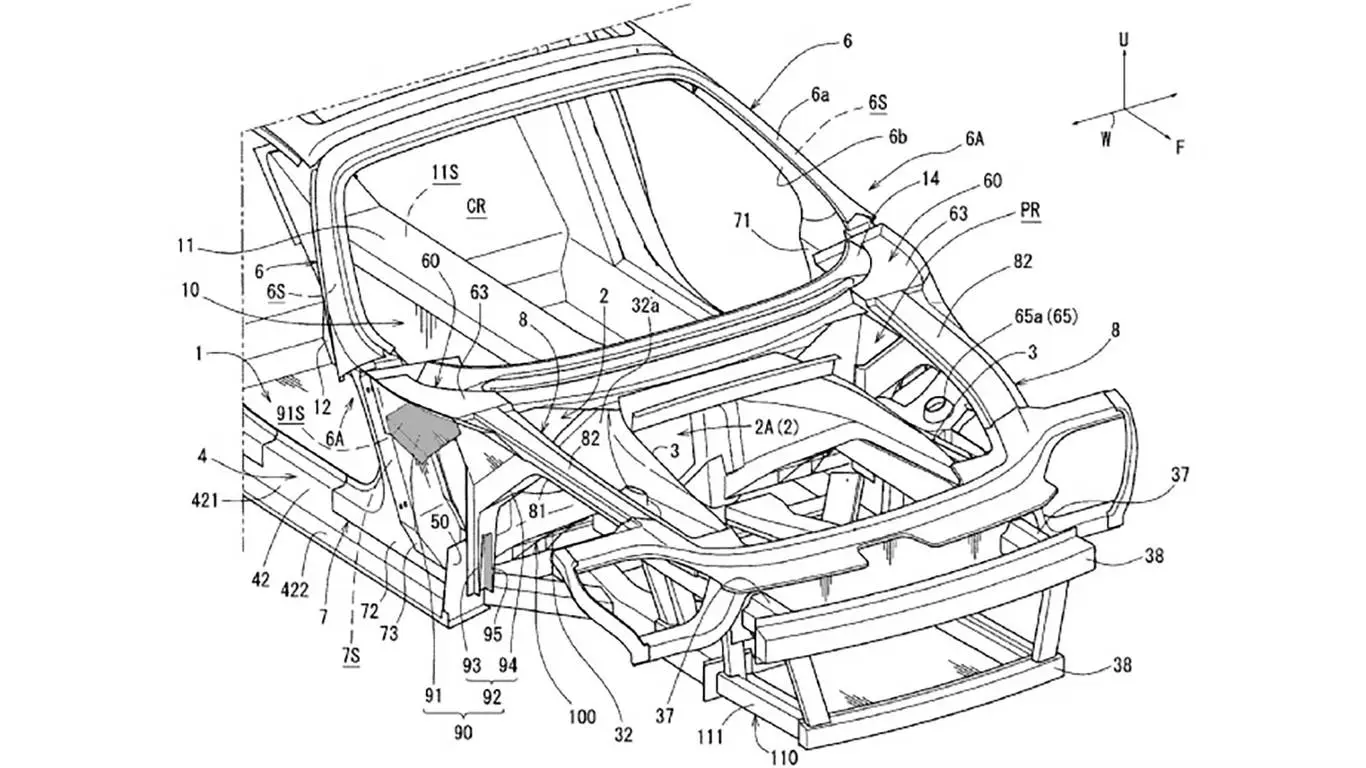
Mazda is stoking interest in lightweight, gas-powered sports cars again — and this time it’s doing it with patents, not a press event. The filings describe a compact car with a front, longitudinally mounted four-cylinder engine, rear-wheel drive, an open body and unusual butterfly doors. So the real question isn’t whether Mazda is working on a sports car, but whether it’s a new MX-5 or a flashier successor to the Iconic SP concept.
At first glance, upward-opening doors look like a styling stunt. For the MX-5, that’s almost heresy: the model has spent decades built around simplicity, low weight and honest mechanics with no theatrics. But in the patent, Mazda frames the layout as an engineering solution. The angled hinge line ties the windshield-pillar structure and door-opening area into the upper front suspension mount. In other words, the “wings” aren’t there for showing off outside a cafe — they’re there to boost body rigidity.
That matters even more on a convertible. A roadster has no roof to act as a structural element, so engineers have to chase rigidity elsewhere — through the sills, the front bulkhead, reinforcements and pillars. The patent also describes additional braces that carry load from the suspension mounts to a reinforced door-opening zone, plus a stamped component that resembles a large brace running between the front corners of the body and the firewall. Mazda is clearly trying to add stiffness without piling on weight.
What makes this intriguing is that the drawings recall not just a future MX-5 but also the 2023 Iconic SP concept. That car had similar proportions: a long hood, a compact cabin and a dramatic side-glass line. Mazda has shown interest in rotary technology before, but bringing that kind of project to production remains difficult. That makes a conventional gas four-cylinder in the patent the more realistic bet for actual manufacturing.
For the market, this counts as rare good news. In an era of heavy electric crossovers and hybrid SUVs, a compact, rear-wheel-drive, combustion-powered sports car feels almost like an anachronism — but it’s exactly the kind of car Mazda built its reputation on. The MX-5 was never about horsepower; it was about weight, balance, driving position, mechanical feel and a connection to the road. If the new structure lets Mazda keep that philosophy while meeting modern safety rules, the odd doors will be easy to forgive.
A production car is far from guaranteed: patents often protect ideas that never make it to the assembly line. But the engineering logic behind this one matters. Mazda, it seems, doesn’t want its next sports car to turn into a heavy gadget on wheels. It’s looking for a way to keep the gas engine, rear-wheel drive and a light body — even if that means the classic Miata has to learn to open its doors upward.